Vision from my point of view
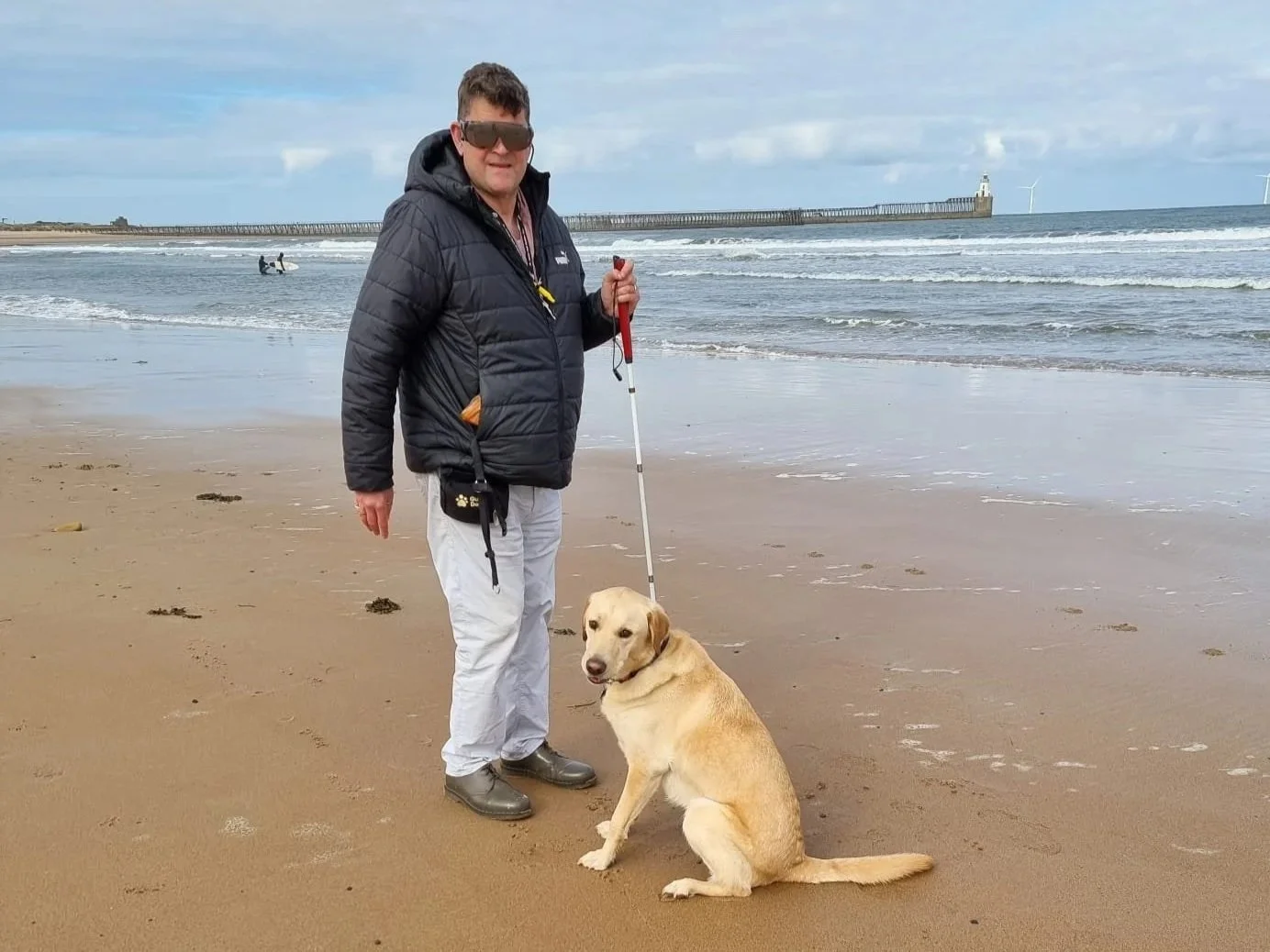
Me and my guide dog enjoying the beach
In October 2021, out of the blue I became seriously ill with Infective endocarditis this led to multiple strokes, a bout of sepsis and a long hospital stay. I don’t recall waking up blind; instead, I have memories of being told about surgeries and gradually adjusting to a new reality.
I spent around five months in hospital. There were periods when the outlook was bleak enough that survival was uncertain. Recovery, when it came, was slow and uneven.
I am now registered blind. That phrase can be misleading. It doesn’t mean total darkness. In my case it means severe visual impairment — a patchwork of loss rather than a single, clean absence.
My vision is difficult to describe to someone who hasn’t experienced something similar. Parts of my visual field are missing. Other areas are present but unreliable: blurred, washed out, or shimmering. Sometimes there are disturbances — flashing lights or visual noise — that appear without warning. Much of the time, the world looks as though I’m underwater, or as though I’ve just stepped out of a bright room and my eyes haven’t yet adjusted. The quality of light also plays a big role in how I see. I do much better in spaces with bright even lighting rather than harsh spotlights, which can be tricky.
For me now it’s about constant interpretation. I am always working out what I am actually seeing, what I think I’m seeing, and what might not be there at all. The brain tries to fill in gaps using memory and expectation, and that can be both helpful and misleading. Familiar places feel safer not because I see them better, but because I already know what should be there.
I find it easier to focus on specific objects rather than taking in a large scene, sometimes it looks like I’ve seen someone when I haven’t, although sometimes I can catch someone’s eye. Crowded or busy environments can be more challenging, if I am struggling to take in what’s in front of me sometimes I take a photograph of it and look at it later on my phone. It can be a bit easier to see things on my phone.
These days I rely on technology for reading, I’ve got a vast library of audio books and RNIB’s talking books are invaluable. My smart speaker, my phones and my computer all read things and help me. They are both amazing and sometimes really exasperating. I can sometimes catch a sign or large print, but sometimes can’t, because what I see varies. The guide dogs large print newsletter is the easiest printed document to read of anything I’ve found and I use a green plastic sheets to stop the white paper dazzling me, but even then it becomes too difficult after a few lines and my vision goes blurred and sparkly. I can manage better with my phone screan sometimes.
I am usually aware of a step or a curb but not always and I can’t judge the depth. Potholes are tricky. I have started using a Guide Dog which has been great. Guide Dogs are an amazing charity. I sometimes carry a cane as a backup.
My Husband, my family and my friends went through the ringer when I was in Hospital, I’m forever grateful for the medical staff who saved my life. I often think about the occupational therapists and Physios who taught me to walk, wash and dress myself again. The hard-pressed vision rehabilitation specialists at the Council got me walking with a cane and getting the bus by myself, I received so much help from so many people in different organisations. I did a ‘Living with Visual Impairment’ course put on by a local charity, Newcastle Vision Support, and I’ve stayed involved with the sight loss community and organisations.
In a strange way I’ve actually loved the recovery journey, so much love and help and support, only the occasional irritated outburst ‘who moved my shoes’ and ‘I know that door is closed!’ I rely on remarkably good, kind and professional support workers. My independence is hard-won and carefully maintained. It involves planning, routines, adaptations, and sometimes asking for help when I’d rather not.
I’m writing this to explain Visual impairment is often invisible to others, and sometimes even to ourselves. It doesn’t always look like darkness. Sometimes it looks like uncertainty. Sometimes it looks like confidence masking effort. Sometimes it looks like someone hesitating at a step you didn’t even notice.
I’m always grateful for the kindness and consideration of others. A simple hello makes a world of difference, and I love that people are curious and want to understand, so if you see me about feel free to chat with me.